Camera Battery Charger Wholesale: 8 Things Importers Should Check
Camera Battery Charger Wholesale looks simple when I only compare unit prices, but the real problems usually appear later: wrong models, slow-moving SKUs, plug mistakes, and customer returns. If I check compatibility, quality consistency, MOQ, packaging, and shipping details before ordering, I can reduce risk and buy with more confidence.
Importers should check eight things before buying camera battery chargers wholesale: supported battery models, charger version, universal compatibility claims, SKU mix, quality stability, MOQ and lead time, plug and packaging details, and sample confirmation. The best wholesale deal is not always the lowest price; it is the order that sells smoothly with fewer returns.
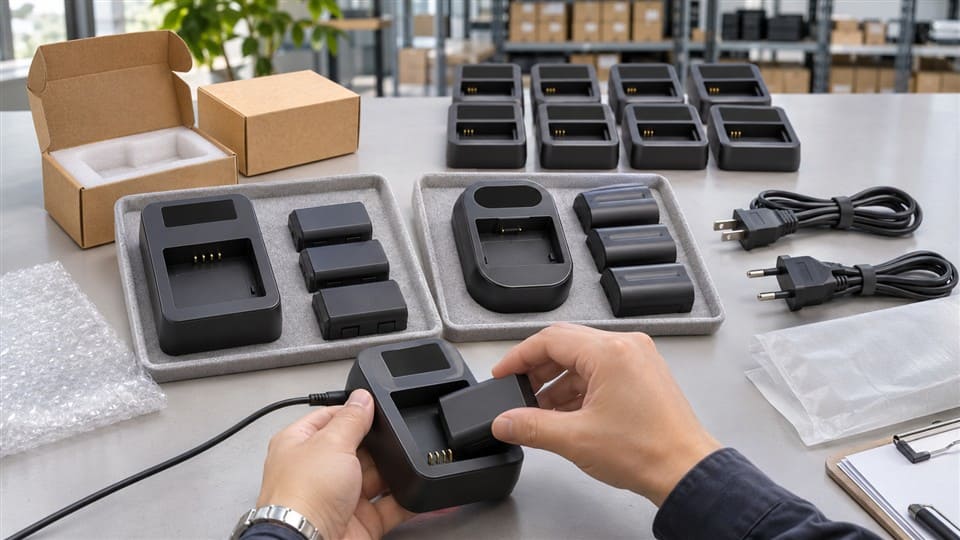
Many importers I speak with ask for price first. I understand that. Price matters a lot in Africa and Latin America. But in daily wholesale communication, I usually need to confirm model details before giving a useful quotation. A cheap charger is expensive if it does not match the battery your customers actually use.
Camera Battery Charger Wholesale Check 1–2: Which Battery Models and Charger Versions Match?
Wrong compatibility is the fastest way to create returns.1 A charger may look correct in a photo, but the battery slot, contact position, voltage, or model code may be different.2 If I skip this step, I may buy stock that is hard to sell.
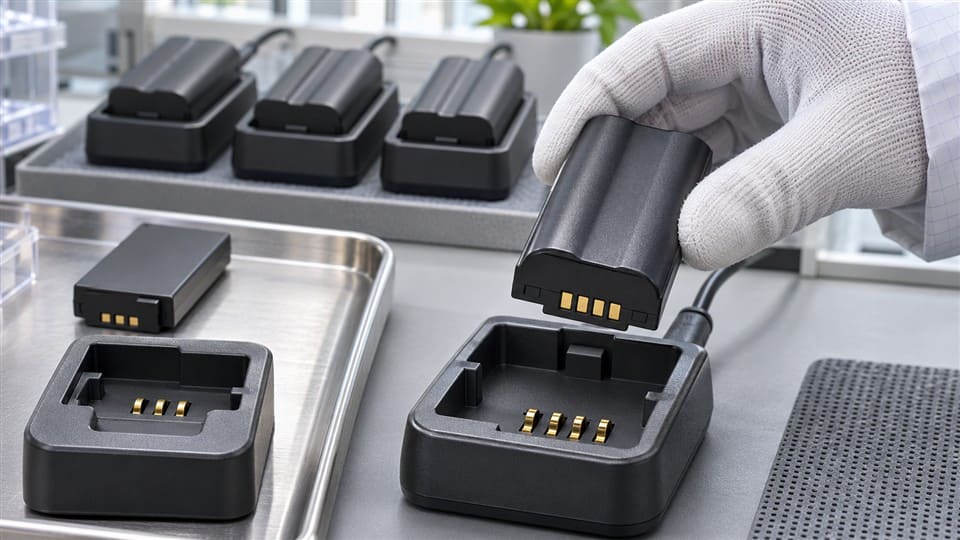
The first two checks are supported battery models and charger version/contact design. Importers should confirm exact battery codes, camera series, charger slot shape, metal contact position, and whether the supplier can repeat the same version in future orders.
1. Supported battery models
In my factory-side experience, many quotation discussions begin with a very simple question: “Which model do you need?” This question is not small. A camera battery charger is not like a normal USB cable where one product fits most customers.
For example, a buyer may say they need a charger for Canon, Nikon, Sony, or Panasonic batteries. That is only the brand level. I still need the battery model number, such as LP-E6, LP-E8, EN-EL14, EN-EL15, NP-FW50, NP-FZ100, DMW-BLC12, and so on.
Importers should prepare:
- Battery model code
- Camera model if available
- Original charger model if available
- Photos of the battery front and back
- Estimated quantity for each model
- Target market, such as Nigeria, Kenya, Brazil, Peru, or Colombia
This helps the supplier quote the correct item instead of guessing.
2. Charger version and contact design
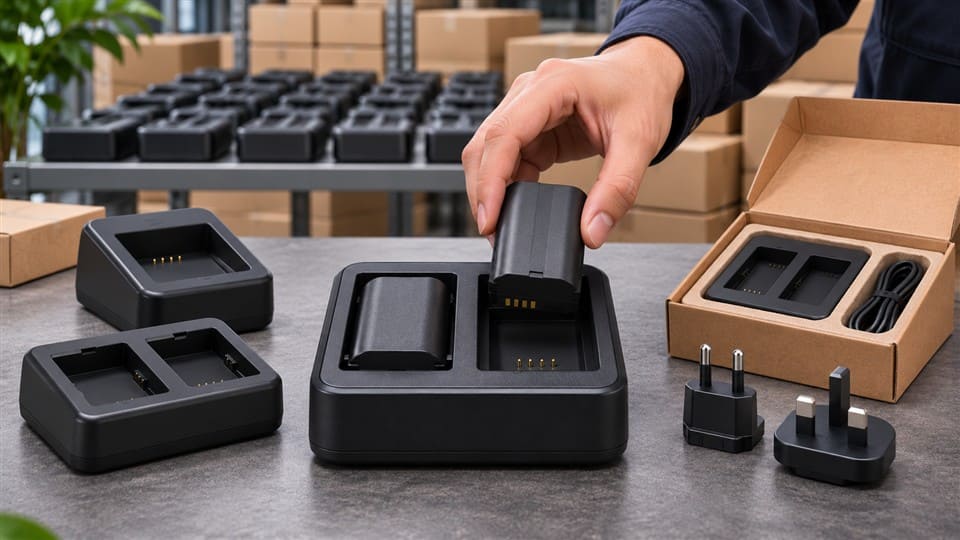
Even if the model name is correct, the charger version still matters. Some chargers use a fixed plate. Some use a sliding plate. Some use a USB input. Some use an AC plug directly. Some have one slot, and some have dual slots.
Here is a simple comparison I often use when talking with buyers:
| Check Point | Why It Matters | Importer Risk If Ignored |
|---|---|---|
| Battery model | Confirms basic compatibility | Wrong SKU, high returns |
| Contact position | Ensures charging connection | Battery cannot charge |
| Input type | Matches user habits | Poor sell-through |
| Single/dual slot | Affects price and use case | Wrong customer segment |
| Charger plate design | Impacts fit and stability | Complaints and returns |
I do not suggest judging only by product photos. Photos can be helpful, but they are not enough. Before bulk ordering, I prefer to confirm a sample or at least confirm clear model photos and specifications with the buyer.
Camera Battery Charger Wholesale Check 3–4: Are Universal Claims and SKU Mixes Really Practical?
“Universal charger” sounds attractive because it seems to reduce inventory pressure. But broad compatibility can also create confusion. If my customers do not understand how to use it, or if it fits too many models poorly, returns may increase.
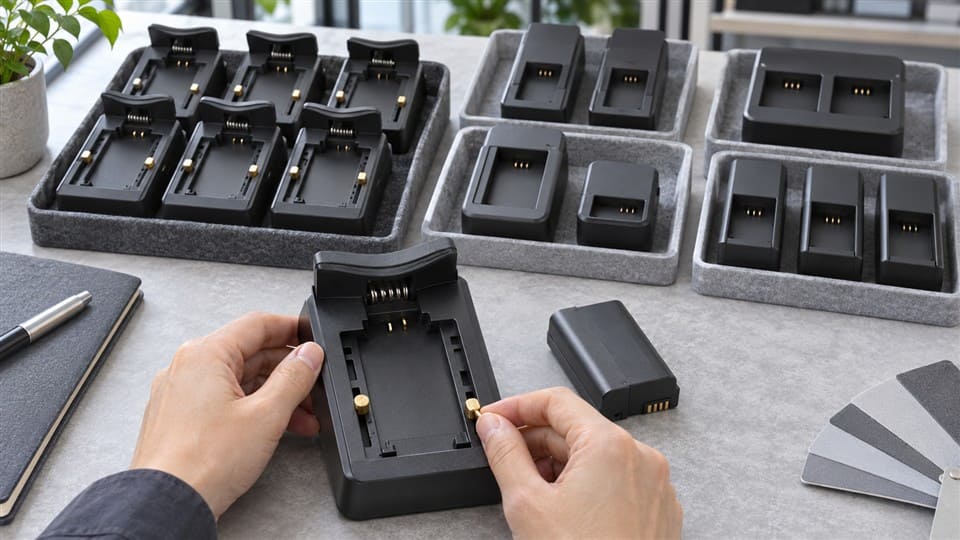
The third and fourth checks are universal charger claims and SKU mix planning. Importers should ask which models are truly supported, how the charger adjusts, which SKUs sell fastest, and whether the order mix matches local demand.
3. Universal charger claims
A universal camera battery charger can be useful, especially for repair shops, small electronics stores, and markets where customers bring many different battery types. However, “universal” does not mean “perfect for every battery.”3
I suggest importers ask direct questions:
- Which battery models are listed as supported?
- Does the charger use adjustable contacts?
- Is charging slower than a dedicated charger?
- Does the package include instructions?
- Has the supplier shipped this model repeatedly before?
This is important because many end users do not like complicated products.4 In wholesale, a product must not only work; it must also be easy to explain and easy to sell.
A universal charger can reduce SKU quantity, but it can also increase customer questions if the design is not clear.
4. SKU mix and sell-through
Importers in Africa and Latin America often ask for a mixed order. That makes sense because the market may need many models in small quantities. But too many slow-moving models can trap cash in inventory.5
A practical SKU mix may look like this:
| SKU Type | Suggested Role | Buying Note |
|---|---|---|
| Fast-moving dedicated chargers | Main sales volume | Keep stable stock |
| Universal chargers | Flexible backup | Confirm user instructions |
| Dual chargers | Higher-value option | Good for pro users |
| USB chargers | Budget and travel use | Check cable and input |
| OEM/private label chargers | Brand building | Needs packaging planning |
When I discuss orders, I like to separate SKUs into main models, test models, and special models. Main models can take larger quantity. Test models can be ordered in smaller quantity first. Special models should be carefully checked because they may move slowly.
This is why I do not think the cheapest full container of mixed chargers is always the best deal. The better order is the one where the importer can sell most SKUs within a reasonable time and reorder the fast-moving ones.
Camera Battery Charger Wholesale Check 5–6: Do Quality Stability and MOQ Support Repeat Orders?
A low price is easy to notice, but unstable quality is harder to calculate before ordering. If the charger fails too often or changes version without notice, the importer may lose time, money, and customer trust.
The fifth and sixth checks are quality stability and MOQ, lead time, and repeat supply ability. Importers should review samples, confirm production consistency, ask about after-sales handling, and check whether the supplier can repeat the same SKU over time.
5. Quality stability and after-sales risk
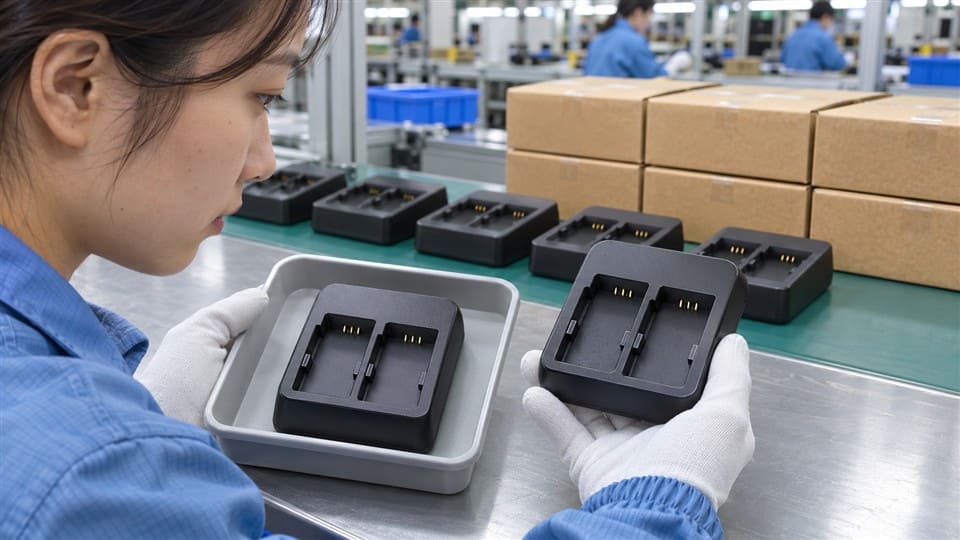
I am a source factory/supplier, so I look at quality from a practical wholesale angle. I do not pretend to be a certification body or laboratory. For importers, the key question is simple: Will this charger be stable enough for my channel?
Before placing a large order, importers can check:
- Sample appearance
- Plastic housing fit
- Battery fit in the slot
- LED indicator behavior
- Cable or plug quality
- Heat during normal use
- Packaging protection
- Basic charging performance with the target battery
If certifications or test documents are mentioned, buyers should verify them directly and check whether they match the product and supplier.6 This is especially important for private-label or regulated market channels.
After-sales cost is also real. If a charger has a very low unit price but creates many returns, the final cost becomes higher. For example, a return may include replacement cost, local delivery cost, customer service time, and damage to the seller’s reputation.7
6. MOQ, lead time, and repeat supply
MOQ is not just a number. It affects cash flow, stock pressure, and product testing. Some importers want very small quantities for many models. Some want large quantities for a few hot models. Both approaches can work, but the supplier needs clear information.
A useful inquiry usually includes:
- Model numbers needed
- Quantity per model
- Plug type
- Packaging type
- Destination country
- Logo or neutral packaging request
- Expected order time
- Shipping method preference
Lead time also matters. If a buyer sells through local shops, ecommerce, or distributor channels, stock gaps can hurt repeat sales.8 A supplier who can repeat the same SKU and keep stable communication may be more valuable than a supplier who gives a slightly lower first quote.
For wholesale camera charger sourcing, I usually suggest importers test a sample first, then place a trial order, then scale up the fast-moving SKUs. This is safer than buying many random models at once only because the unit price looks attractive.
Camera Battery Charger Wholesale Check 7–8: Are Plug Type, Packaging, and Shipping Details Ready?
A charger can be compatible and stable, but the order can still have problems if the plug, label, package, or shipping detail is wrong. These “small” details often decide whether stock sells smoothly in the local market.
The seventh and eighth checks are local market details and sample/inquiry confirmation. Importers should confirm plug type, packaging language, barcode needs, carton marks, shipment terms, and final sample approval before bulk production.
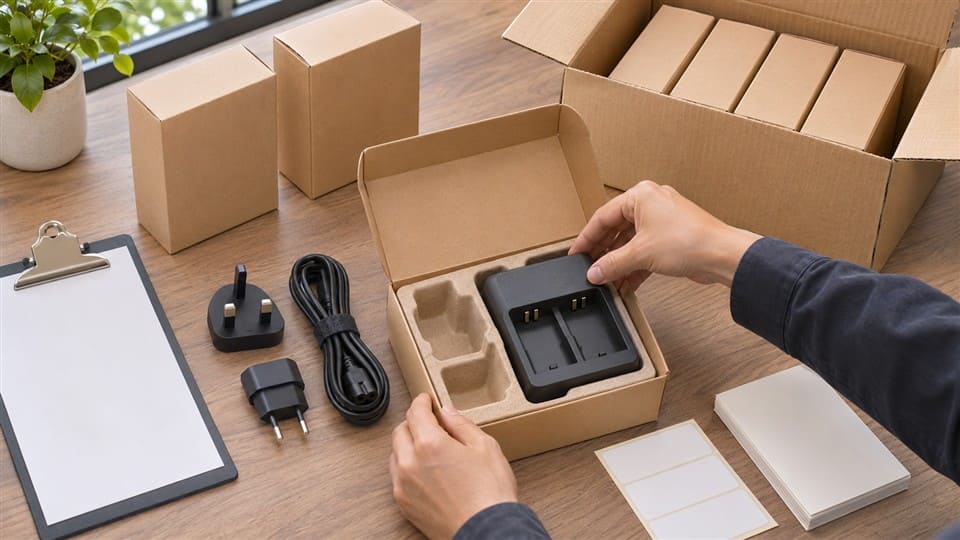
7. Plug type, packaging, and labels
For Africa and Latin America, plug type is not something I want to guess. Different markets may use different plug standards9, and local customers notice immediately when the plug does not fit their wall socket.
Importers should confirm:
- EU plug, US plug, UK plug, or other plug type
- USB input charger or direct AC charger
- Neutral box, color box, or blister package
- English, Spanish, Portuguese, or French wording
- Barcode or SKU label
- Carton mark and model sticker
- Private label logo if needed
Packaging also affects selling. A simple neutral box may work for wholesale distribution. A color box may work better for retail shelves. For ecommerce, stronger packaging may reduce damage during local delivery.
Here is a simple way to choose:
| Sales Channel | Packaging Suggestion | Main Reason |
|---|---|---|
| Wholesale market | Neutral or simple color box | Lower cost, easy stock |
| Retail shop | Color box | Better shelf display |
| Ecommerce | Stronger box and clear label | Less damage and confusion |
| Private label | Custom logo package | Brand building |
8. Sample confirmation and clear inquiry
The final check is communication. I have seen many delays happen because the inquiry is too general. A buyer may ask, “How much is camera charger?” But there are many models, versions, packages, and quantities.
A clear inquiry saves time for both sides. It also helps the supplier give a more accurate price. I recommend sending a short but complete message like this:
“Hello, I need camera battery chargers for LP-E6, EN-EL15, and NP-FW50. Quantity is 500 pcs each model. Destination is Ghana. Please quote EU plug, neutral box, and carton packing details. I also need sample cost and lead time.”
This kind of message helps me reply faster and more accurately.
Before bulk production, importers should confirm:
- Product model
- Charger version
- Plug type
- Packaging
- Label
- Quantity
- Unit price
- Lead time
- Carton size and weight
- Shipping terms
- Sample result
When these details are clear, the wholesale process becomes smoother. The buyer reduces risk, and the supplier can prepare the right products instead of correcting mistakes later.
Frequently Asked Questions
What is the most important check before buying camera battery chargers wholesale?
Compatibility is the most important check. Importers should confirm the exact battery model, charger slot, contact design, and charger version before discussing large quantities. A low price does not help if the charger does not match the battery customers use.
Are universal camera battery chargers good for wholesale?
Universal chargers can be good for wholesale, especially for repair shops and mixed-model markets. However, importers should check the supported model list, adjustable contact design, instructions, and user convenience. Broad compatibility can also create confusion if customers cannot use the charger easily.
Should I choose the cheapest camera battery charger supplier?
The cheapest supplier is not always the best choice. Importers should compare price together with quality stability, MOQ, lead time, packaging, after-sales handling, and repeat supply ability. A slightly higher stable product may reduce returns and protect local customer trust.
What information should I send to get an accurate quotation?
You should send the battery model numbers, quantity per model, plug type, packaging request, destination country, logo needs, and target shipping method. Clear information helps the supplier quote the correct charger and avoid wrong SKU recommendations.
Do I need samples before placing a bulk order?
Yes, samples are strongly recommended. Samples help you check battery fit, contact position, LED indicator, packaging, plug type, and overall quality. For new SKUs or private-label orders, sample confirmation can reduce costly mistakes before mass production.
Conclusion
Camera Battery Charger Wholesale is not only about finding the lowest unit price. I believe importers should first reduce compatibility, inventory, return, and supply risks. The best order starts with exact battery models, clear charger versions, realistic SKU planning, stable quality, suitable MOQ, correct plug type, and confirmed packaging. If you source for Africa or Latin America, send me your model list, quantity, plug type, and packaging needs, and I can help you prepare a practical wholesale quotation.
-
"ESSAYS ON PRODUCT RETURNS IN A CLOSED-LOOP SUPPLY CHAIN", https://etda.libraries.psu.edu/files/final_submissions/15436. Studies of retail and e-commerce returns identify product mismatch, fit, or unmet expectations as recurring reasons for returns, supporting the need to verify charger compatibility before wholesale purchase; the evidence is contextual because it is usually not specific to camera battery chargers. Evidence role: general_support; source type: paper. Supports: Research should show that mismatch between product attributes, customer expectations, or product fit is associated with higher return rates.. Scope note: Contextual support from broader product-return research rather than charger-specific return statistics. ↩
-
"Battery Management System for Charge CCCV, Inc.", https://ziang.binghamton.edu/battery-management-system/. Technical educational sources on lithium-ion charging explain that chargers must match the battery pack’s voltage requirements and electrical contact arrangement, which supports checking charger slot design and contact position before ordering. Evidence role: mechanism; source type: education. Supports: A source should explain that rechargeable lithium-ion battery packs require chargers with appropriate voltage, current control, and physical/electrical connection design.. ↩
-
"Lithium-ion battery", https://en.wikipedia.org/wiki/Lithium-ion_battery. Research and technical references on rechargeable-battery charging show that charging profiles depend on battery chemistry, voltage, and charge-control requirements, supporting the caution that a universal charger may not be appropriate for every battery. Evidence role: mechanism; source type: research. Supports: A neutral source should explain that battery charging depends on chemistry, voltage, current limits, and charge-control method.. ↩
-
"A systematic review of user-based usability testing practices in self …", https://pmc.ncbi.nlm.nih.gov/articles/PMC12397588/. Human-factors and usability research defines usable products by effectiveness, efficiency, and user satisfaction, supporting the claim that complex charger designs can create user friction; the source would support the general usability principle rather than camera-charger behavior specifically. Evidence role: expert_consensus; source type: paper. Supports: A source should support the relationship between usability, task success, user satisfaction, and error rates.. Scope note: General usability evidence, not direct evidence about universal camera chargers. ↩
-
"A comparison of inventory carrying cost in literature and in practice", https://dr.lib.iastate.edu/bitstreams/8d2b0874-381d-4752-b619-a8d340042d5d/download. Inventory-management sources describe unsold stock as capital tied up in inventory and subject to carrying costs, supporting the warning that excessive slow-moving SKUs can reduce cash flexibility. Evidence role: general_support; source type: education. Supports: A university or textbook-style source should explain that inventory has carrying costs and ties up capital until sold.. ↩
-
"General Use Products: Certification and Testing", https://www.cpsc.gov/Business–Manufacturing/Testing-Certification/General-Use-Products-Certification-and-Testing. Official product-compliance guidance states that conformity documents should identify the product, responsible party, and applicable requirements, supporting the practice of verifying that certificates match the charger model and supplier. Evidence role: general_support; source type: government. Supports: An official source should explain that compliance documents such as declarations of conformity should identify the product, manufacturer, and applicable requirements.. ↩
-
"Retail Returns and Reverse Logistics", https://minds.wisc.edu/bitstreams/d2b8eac7-3f8d-4179-a173-319f709b82d3/download. Reverse-logistics research describes product returns as creating costs for transport, handling, processing, replacement, and customer service, supporting the claim that a low unit price can be offset by return-related expenses. Evidence role: general_support; source type: paper. Supports: A source should describe the operational and financial costs associated with product returns, including logistics, handling, replacement, and customer-service costs.. ↩
-
"Towards understanding consumer response to stock-outs", https://www.academia.edu/9279104/Towards_understanding_consumer_response_to_stock_outs. Retail stockout studies find that unavailable products can lead consumers to delay purchases, switch stores or brands, or abandon purchases, supporting the claim that stock gaps may damage repeat sales. Evidence role: general_support; source type: paper. Supports: A source should show that stockouts can lead to lost sales, consumer switching, or reduced future purchasing.. ↩
-
"AC power plugs and sockets", https://en.wikipedia.org/wiki/AC_power_plugs_and_sockets. International references on mains plugs and sockets document that plug types and electrical outlet standards differ across countries, supporting the need to confirm the plug type for each destination market. Evidence role: definition; source type: institution. Supports: A source should document that countries use different plug and socket types and mains standards.. ↩