How Long Does It Take to Charge a Camera Battery?

How long does it take to charge a camera battery? I hear this question often from users, dealers, and wholesalers who need reliable shooting time without surprise delays. The problem is that charging time is not fixed. A slow charge can feel like a product fault, but the real answer depends on battery capacity, charger output, remaining power, and safety design.
Most camera batteries take about 1.5 to 4 hours to charge, but this is only a general reference. The actual time changes with the battery’s mAh capacity, charger current, starting power level, charging method, heat control, and protection circuit behavior. A faster charger is not always better if it creates heat or does not match the battery properly.
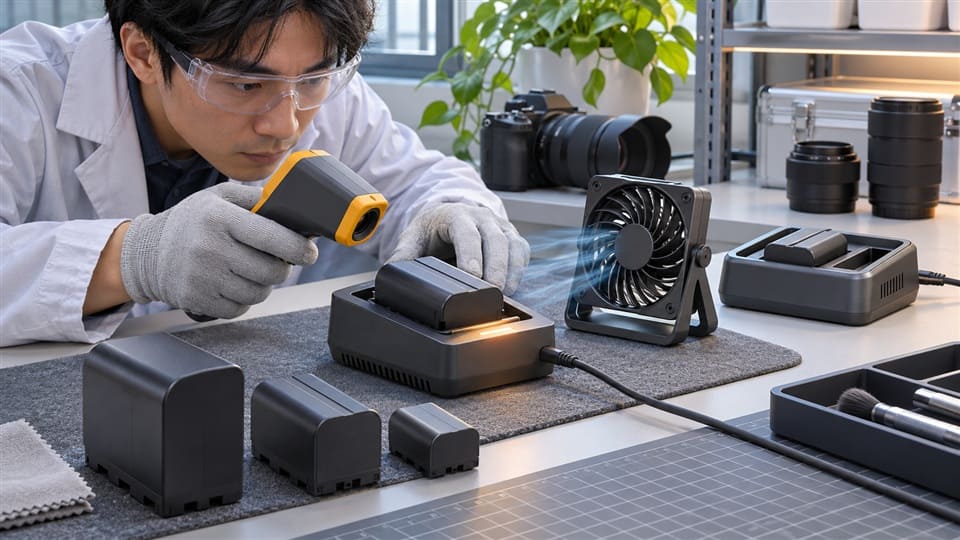
I work from the camera battery and charger supply-chain side, so I look at this question differently. I do not only ask, “How fast is it?” I also ask, “Is this charging setup safe, stable, and clear enough for real customers to understand?”
What affects how long it takes to charge a camera battery?
A camera battery may charge slowly, and that can be frustrating when a shoot is coming soon. The bigger problem is that many users only check the battery size and ignore the charger. That creates wrong expectations. The solution is to read both the battery and charger specs together.
A camera battery charging time mainly depends on battery capacity, charger output current, remaining charge level, charging method, temperature, and internal protection design. A larger battery usually takes longer1. A lower-output USB charger also takes longer. A battery starting at 20% charges faster than one starting near 0%.

Battery capacity is only one part of the answer
Many buyers first look at mAh, such as 1,000mAh, 1,500mAh, or 2,000mAh. That number matters because it shows how much energy the battery can store. In simple terms, a larger tank takes longer to fill.
But I have seen many buyers make one mistake: they compare batteries only by capacity and forget the charger output.
For example:
| Battery Capacity | Charger Output | Rough Charging Expectation |
|---|---|---|
| 1,000mAh | 500mA | Around 2–3 hours |
| 1,500mAh | 700mA | Around 2.5–3.5 hours |
| 2,000mAh | 1,000mA | Around 2.5–4 hours |
| 2,000mAh | 500mA | Often 4+ hours |
These are not fixed promises. They are practical reference points. Real charging includes power loss, heat control, and the slower final charging stage.
The final 20% often feels slow
Lithium-ion camera batteries usually do not charge at the same speed from 0% to 100%. Charging is often faster in the middle and slower near the end. This is normal because the charging circuit reduces current near full capacity to protect the cell.
That is why a user may see the battery reach “almost full” quickly, then wait a long time for the final indicator light to change.
Dealers should explain this clearly
For dealers in Africa, Latin America, and other price-sensitive markets, clear expectation-setting reduces complaints. If customers expect a full battery in 45 minutes but the normal time is 2.5 hours, they may think the product is defective.
I usually suggest that sellers provide simple guidance like:
- “First full charge may take longer.”
- “Use the matched charger for stable charging.”
- “Charging time changes with remaining battery level.”
- “Avoid charging under strong heat or direct sunlight.”
Small explanations can prevent many return requests.
Is it safe to charge a camera battery faster?
Fast charging sounds attractive, especially when a photographer has only one battery before an event. The risk is that speed can hide a trade-off. If the charger pushes current too aggressively, the battery may heat up, age faster, or trigger protection behavior.
It can be safe to charge a camera battery faster only when the battery, charger, voltage, current, and protection design are properly matched. Faster charging is not automatically better. A safe charger should control current, manage heat, and follow the battery’s supported charging range.
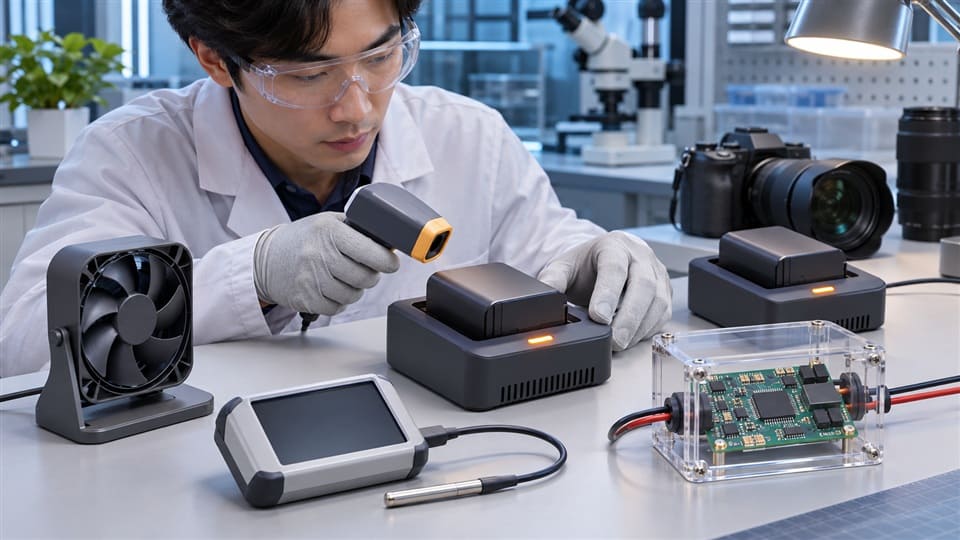
Fast charging is a matching question
From the factory and supply-chain side, I always look at the full combination:
- Battery cell capacity
- Protection board design
- Charger output voltage
- Charger output current
- Connector and contact quality
- Heat behavior during charging
A charger with higher output does not always mean the battery will charge much faster. Some batteries have internal limits. Some chargers reduce current automatically. Some camera batteries charge through dedicated pins, while others charge through USB in the camera body.
Heat is the warning sign
Heat is one of the most practical things users can check2. A slightly warm battery can be normal. A hot battery is not something to ignore.
I usually tell customers:
If a battery becomes very hot during charging, stop charging it and check the charger, cable, battery condition, and charging environment.
- Battery cycle life
- Charging stability
- Safety protection behavior
- Customer confidence
- Return rate for dealers
Faster is not always better for resale
For wholesalers and dealers, a “fast charger” can be a good selling point only if it is stable and matched. If speed creates heat complaints, swollen battery reports, or short battery life, the return cost may be higher than the sales benefit.
A more balanced product message is often better:
| Claim Type | Risk Level | Better Wording |
|---|---|---|
| “Super fast charging for all batteries” | High | Too broad and risky |
| “Charges faster than standard low-output USB chargers” | Medium | More realistic |
| “Designed for compatible camera battery models” | Lower | Clearer and safer |
| “Includes overcharge and short-circuit protection” | Lower | Good, but buyers should verify specs |
Certifications and protection claims should be checked with supplier documents, test reports, and actual sample evaluation. I can explain the design logic, but application-specific safety decisions should be verified by qualified professionals or technical buyers.
Can a USB charger change camera battery charging time?
USB charging is convenient, but convenience can create confusion. A user may plug the same battery into a laptop, wall adapter, power bank, or car charger and expect the same result. Then the charging time changes, and the user blames the battery.
A USB charger can change camera battery charging time because USB power sources provide different output levels4. A laptop USB port may charge slowly, while a higher-quality wall adapter may charge faster. Cable quality, charger design, and current limits also affect the final charging speed.
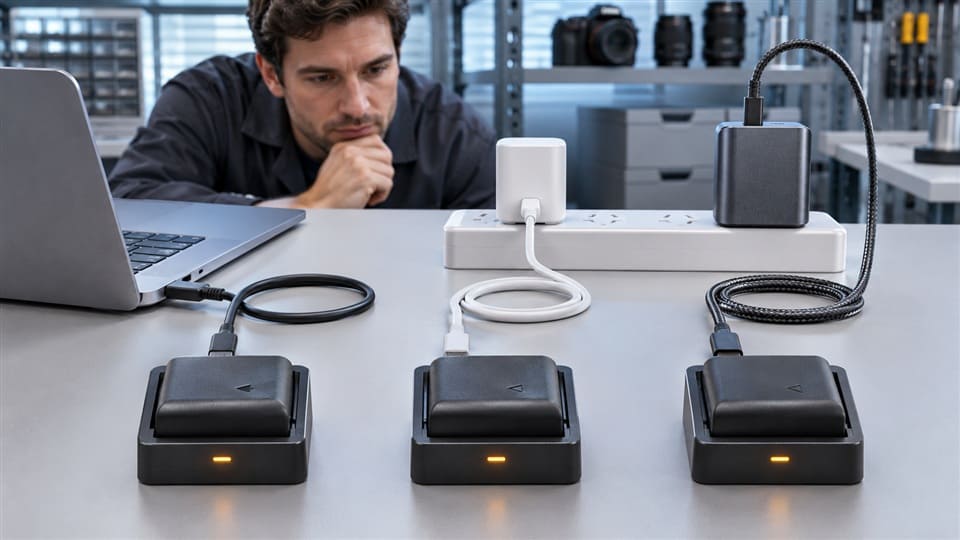
USB charging is not one standard experience
Many camera battery chargers now use USB input because it is easy for global markets. This is especially useful in regions where customers already use phone chargers, power banks, or solar power systems.
But USB input does not mean every power source performs the same.
Common examples:
| Power Source | Typical User Experience |
|---|---|
| Laptop USB port | Often slow |
| Low-cost phone adapter | May be unstable or slow |
| Quality 5V/2A adapter | Usually better |
| Power bank | Depends on output and battery level |
| Car USB port | Can vary a lot |
A charger may say “USB charger,” but the real output to the camera battery depends on the charger circuit and input power quality.
Cable quality also matters
A weak cable can reduce charging current. I have seen users replace the charger when the real issue was the cable. Thin or damaged cables can cause voltage drop, slow charging, or unstable indicator lights.
For buyers and dealers, it helps to test the full set:
- Battery
- Charger
- USB cable
- Wall adapter
- Charging environment
If one part is poor, the whole charging experience suffers.
Dedicated chargers are easier to control
A dedicated camera battery charger usually gives more predictable results than charging through random USB sources. It also helps dealers explain charging time more clearly.
For example, if a product package includes a matched charger, the seller can say:
- “Use the included charger for best charging stability.”
- “Third-party adapters may change charging time.”
- “Avoid very low-output USB ports.”
This kind of wording is simple, but it reduces misunderstanding. For wholesalers, that means fewer support messages and fewer “battery not charging” complaints.
How should buyers choose a charger to charge a camera battery?
Choosing the cheapest charger may save money at first, but it can create problems later. A poor charger may charge slowly, heat too much, fail early, or confuse customers with unstable lights. The better approach is to evaluate both cost and reliability.
Buyers should choose a charger by checking compatibility, output rating, protection features, build quality, indicator clarity, sample performance, and supplier documentation. A good camera battery charger should balance speed, safety, cost, and customer expectations instead of focusing only on the fastest possible charging time.
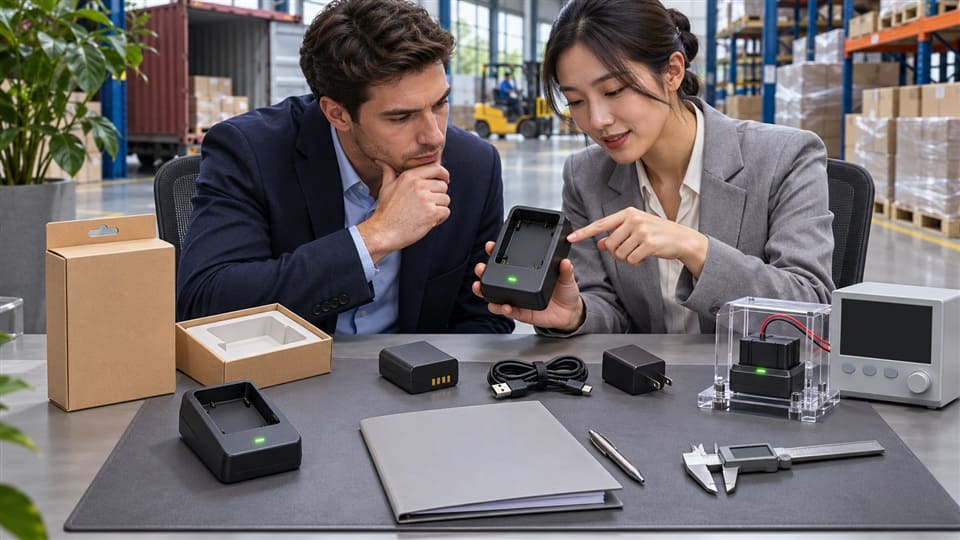
What I check before recommending a charger
When I look at camera chargers from a supply-chain angle, I do not only ask for the price. Price matters, especially for Africa and Latin America, but product stability matters too.
Here is my basic checklist:
-
Model compatibility
The charger must match the battery model and contact design. -
Output voltage and current
The output should fit the battery charging requirement. -
Protection functions
Buyers should check for overcharge, overcurrent, short-circuit, and temperature-related protection where applicable. -
Indicator light behavior
Customers need to understand red, green, flashing, or full-charge signals. -
Heat performance
The charger should not become excessively hot under normal use. -
Housing and contact quality
Poor contacts can cause unstable charging. -
Supplier documents
Certifications, test reports, and material claims should be verified, not only advertised.
For dealers, fewer complaints are part of the product value
A very cheap charger may look attractive on a quotation sheet. But if it causes customer complaints, the real cost becomes higher.
Dealers should consider:
- Return rate
- Warranty cost
- Customer education needs
- Packaging instructions
- Long-term supplier support
- Consistency between production batches
In my experience, a small improvement in charger quality can reduce many after-sales issues. Customers may forgive a 3-hour charge if they were told to expect it. They are less forgiving when charging time is unclear, the light behavior is confusing, or the battery becomes too hot.
A practical buying comparison
| Buyer Priority | Best Focus | Possible Risk |
|---|---|---|
| Lowest price | Basic charger | More complaints if quality is weak |
| Fast charging | Higher output design | Heat risk if not matched |
| Stable resale | Matched charger + clear instructions | Slightly higher unit cost |
| Professional use | Branded or verified high-quality charger | Higher purchase price |
| Remote markets | USB input + durable cable | Power source variation |
For many of my customers, the best option is not the fastest charger. It is the charger that gives stable charging, clear indicators, acceptable speed, and low complaint risk.
Frequently Asked Questions
Why does my camera battery take so long to charge?
Your camera battery may take long to charge because the charger output is low, the battery capacity is large, the battery started near 0%, or the charging circuit slows down near full capacity. USB ports, weak cables, and hot environments can also increase charging time.
Is overnight charging safe for a camera battery?
Overnight charging may be acceptable with a properly matched charger and working protection circuit, but I do not recommend making it a habit. It is better to unplug the battery after it reaches full charge, especially when using low-cost or unverified chargers.
Does a higher mAh camera battery always take longer to charge?
A higher mAh battery usually takes longer if the charger output stays the same. However, charging time also depends on charger current, battery design, remaining charge, and safety controls. A larger battery with a stronger matched charger may not feel much slower.
Can I use a phone charger for my camera battery charger?
You can use a phone adapter only if the camera battery charger supports that USB input rating. A quality 5V/2A adapter often works better than a weak USB port. Always check the charger label and avoid damaged cables or unstable adapters.
Should I buy extra batteries instead of a faster charger?
For long shooting days, extra batteries are often more practical than chasing the fastest charger. A spare battery reduces pressure, avoids unsafe charging shortcuts, and helps photographers keep working while another battery charges.
Conclusion
How long does it take to charge a camera battery? In most real cases, it may take around 1.5 to 4 hours, but the better answer depends on capacity, charger output, starting power, USB source, heat control, and protection design. Faster charging is useful only when the battery and charger are properly matched. If you buy or resell camera batteries and chargers, I can help you compare practical options from a factory-side view, with cost, stability, and customer expectations in mind.
-
"A Guide to Understanding Battery Specifications", https://web.mit.edu/evt/summary_battery_specifications.pdf. Larger batteries with higher mAh ratings generally take longer to charge because they store more energy, requiring more time to reach full capacity at a given charger output. Evidence role: mechanism; source type: education. Supports: Explains the relationship between battery capacity and charging time.. Scope note: Charging time also depends on charger output and battery design. ↩
-
"Battery Safety | Environmental Health & Safety (EHS)", https://ehs.virginia.edu/Chemical-Safety/Battery-Safety. Excessive heat during lithium-ion battery charging can lead to reduced battery lifespan, safety risks, and potential thermal runaway, making temperature monitoring a critical safety measure. Evidence role: mechanism; source type: research. Supports: Explains why monitoring heat is important for battery charging safety.. Scope note: Specific temperature thresholds may vary by battery model and manufacturer. ↩
-
"Heat Generation and Degradation Mechanism of Lithium-Ion Batteries …", https://pmc.ncbi.nlm.nih.gov/articles/PMC9753165/. High temperatures can degrade lithium-ion battery cycle life, reduce charging stability, and increase safety risks, as supported by studies on thermal effects in battery systems. Evidence role: general_support; source type: research. Supports: Describes the negative effects of high temperature on battery performance and safety.. Scope note: Specific impacts may vary depending on the battery’s design and operating conditions. ↩
-
"USB hardware", https://en.wikipedia.org/wiki/USB_hardware. USB power sources can provide different output levels, typically ranging from 0.5A for USB 2.0 ports to 3A or more for USB-C Power Delivery ports, which can significantly impact charging times. Evidence role: general_support; source type: education. Supports: Describes how USB power sources can vary in output levels, affecting charging times.. Scope note: Specific output levels depend on the USB version and the device’s power requirements. ↩