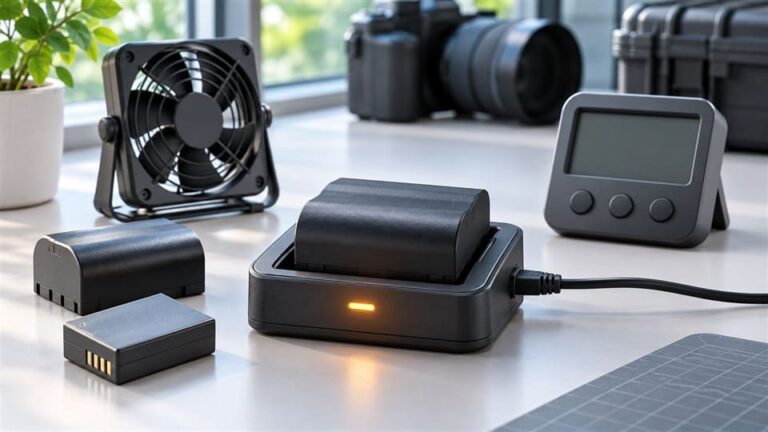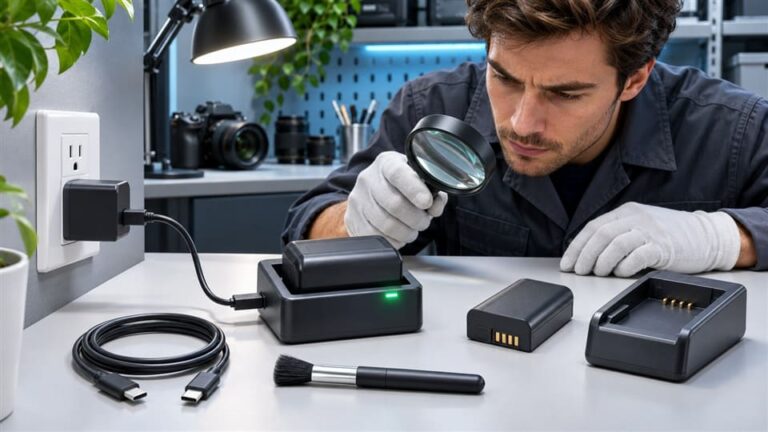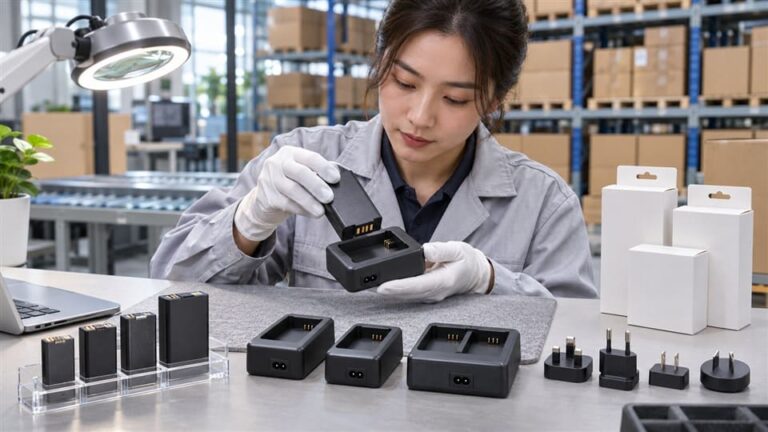
How to Choose a Camera Battery Charger Manufacturer in China
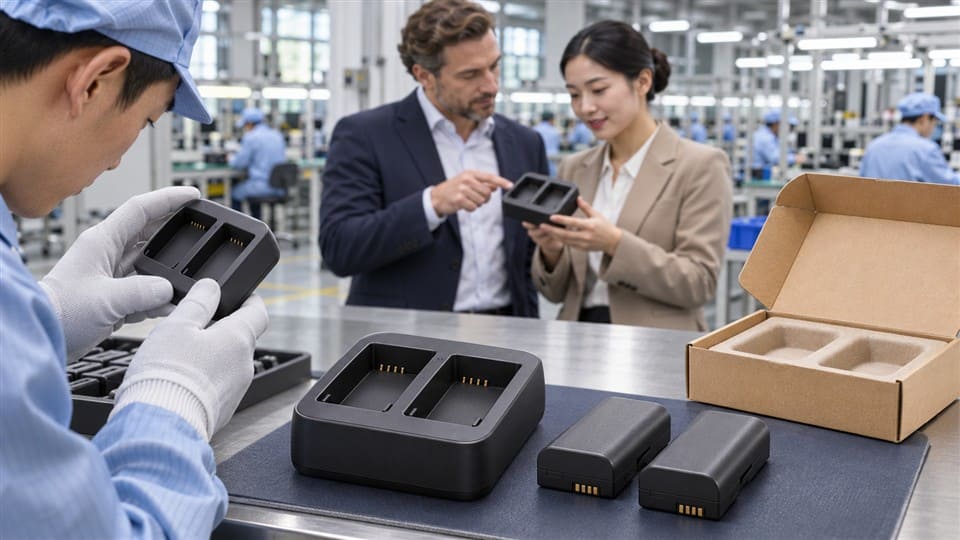
Choosing a camera battery charger manufacturer in China can feel simple at first: ask for a price, compare a few quotations, and pick the lowest one. But that can create returns, charging complaints, and lost profit later. I usually suggest buyers compare the full purchasing risk, not only the unit price.
To choose a camera battery charger manufacturer in China, buyers should evaluate product compatibility, charging stability, quotation details, MOQ, lead time, packaging, and after-sales support. The best choice is not always the cheapest supplier. It is the manufacturer that can keep quality, price terms, and repeat-order supply stable for your market.
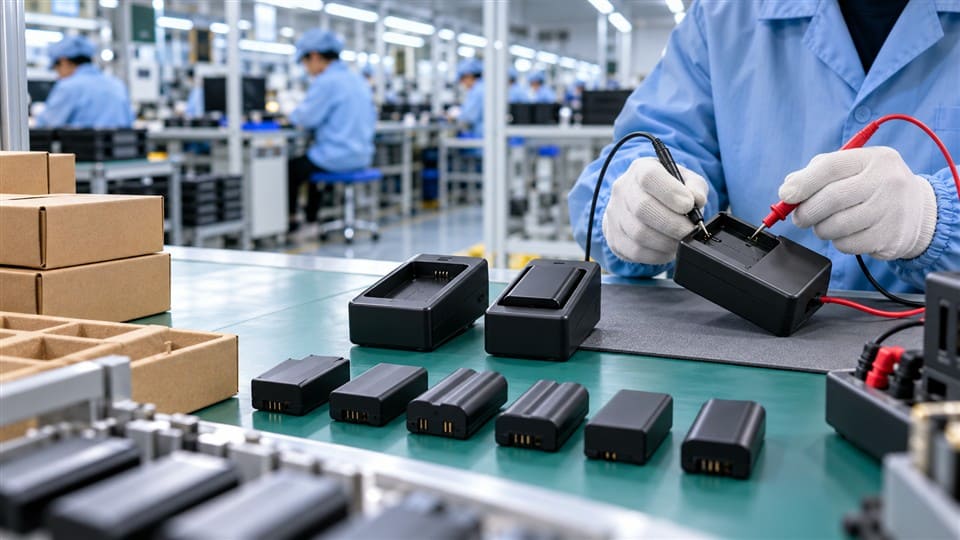
Many buyers from Africa and Latin America ask me for “best price” first. I understand that. Price matters a lot in competitive markets. But after many quotation discussions, I have learned that the better question is: Will this charger sell smoothly and reduce return risk after it reaches your customers?
Why Is a Camera Battery Charger Manufacturer in China Not Only About Low Price?
Low price looks attractive when margins are tight. But if the charger has unstable performance, weak packaging, or unclear compatibility, the buyer may pay more later through returns and customer complaints. A cheap order can become expensive very quickly.
A camera battery charger manufacturer in China should be judged by total purchasing cost, not only unit price. Buyers should compare what the price includes: charger materials, cable or plug options, packaging, MOQ, lead time, model compatibility, warranty handling, and repeat-order stability.
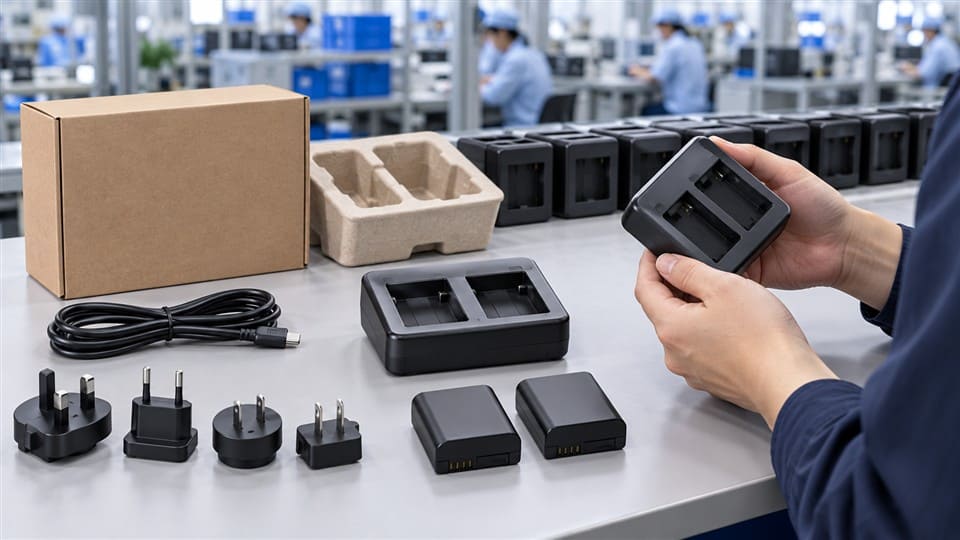
Unit Price Is Only One Part of the Real Cost
When I talk with importers and wholesalers, I often see the same situation. One supplier offers a very low price, and another supplier offers a slightly higher price. At first, the cheaper option looks better. But after asking more questions, the buyer may discover differences in:
- Plastic shell quality
- Charging contact design
- USB cable quality
- Plug type or adapter inclusion
- Retail box strength
- Compatibility range
- Warranty or replacement policy
- Carton packing strength
- Repeat-order price stability
For camera accessory products, these details matter.1 A charger is not a fashion item where only the outside look matters. Customers use it with camera batteries, and if charging feels slow, loose, hot, or unreliable, they complain quickly.
A Simple Total Cost Comparison
Here is a practical way to compare quotations:
| Evaluation Item | Low Unit Price Supplier | More Stable Manufacturer |
|---|---|---|
| Unit price | Lower | Slightly higher |
| Compatibility confirmation | Maybe unclear | Model list confirmed |
| Packaging | Basic or weak | Better for resale |
| Lead time | Unclear | More predictable |
| After-sales handling | Not clear | Discussed before order |
| Repeat order stability | Risky | Easier to plan |
| Return risk | Higher | Lower |
A lower price may still be a good choice if the supplier can explain the product clearly. I do not think buyers should reject low prices automatically. As a source factory, I know price advantage is important. But the price must be connected to real specifications.
Questions I Suggest Buyers Ask
Before you accept a quotation, ask:
- What exactly is included in this price?
- Does the price include retail box, cable, plug, or only the charger?
- Which battery models are compatible?
- What is the MOQ for mixed models?
- What is the normal production lead time?
- How do you handle defective items or after-sales issues?
- Can you keep the same price and packaging for repeat orders?
These questions are simple, but they reveal a lot. A serious manufacturer can usually answer them clearly. If the answer is always “yes, no problem” without details, I would slow down and confirm again.
How Should You Check Camera Battery Charger Compatibility Before Ordering?
Compatibility is a common risk in camera battery charger sourcing. Many chargers look similar in photos, but they may support different battery models. If a charger does not match the local hot-selling camera batteries, retailers may struggle to sell it.
Buyers should ask the supplier how they confirm compatibility with target battery models. A reliable supplier should provide a clear compatible model list, explain which camera battery series the charger supports, and help match products to the buyer’s local market demand.
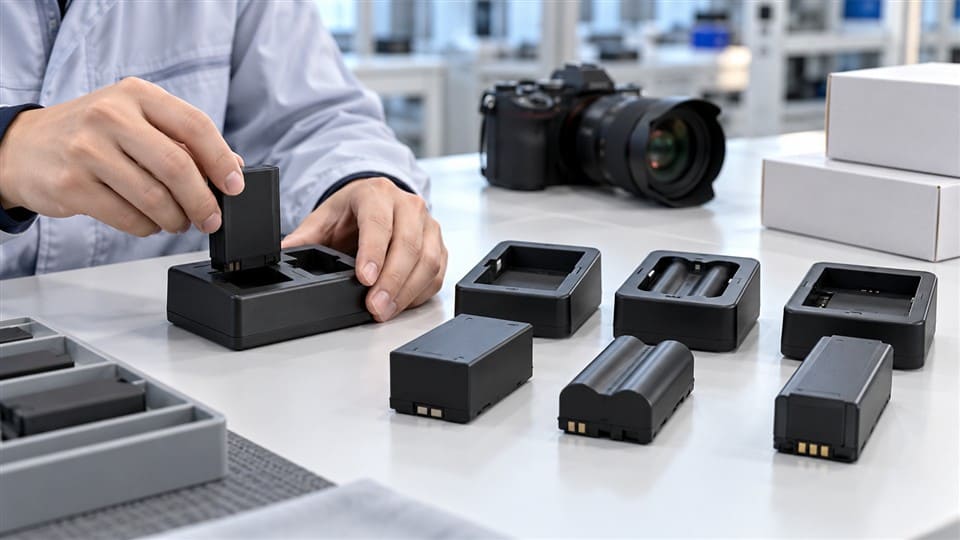
Compatibility Is Not a Small Detail
In many African and Latin American markets, camera accessory buyers often focus on fast-moving models. These may include popular batteries for Canon, Nikon, Sony, Panasonic, Fujifilm, or other camera brands. The exact demand depends on the local retail market.
The problem is that battery model names can be confusing.2 A buyer may ask for a charger for one camera battery series, but the market may use different names or replacement codes. If the supplier does not confirm carefully, the shipment may include chargers that are hard to sell.
I have seen buyers send a photo of a battery and ask, “Can you supply this charger?” That is a good start, but it is better to also send:
- Battery model number
- Camera model if available
- Local selling name
- Photo of battery front and back
- Current charger style sold in the market
- Required plug type or USB cable type
What Buyers Should Confirm
Before placing the order, I suggest confirming these points in writing:
| Compatibility Point | Why It Matters |
|---|---|
| Battery model number | Prevents wrong charger selection |
| Charger slot design | Affects physical fit |
| Charging contact position | Affects charging connection |
| Output information | Helps compare charger type |
| Cable or plug input | Affects customer usability |
| Local hot-selling models | Improves inventory turnover |
This does not mean every buyer must become an engineer. It means the buyer should make the supplier responsible for giving a clear matching answer.
Ask for a Model Support List
A good supplier should be able to say something like:
“This charger supports battery models A, B, and C. Please confirm which models are popular in your market before ordering.”
That kind of answer is better than “all models available.” Camera battery charger sourcing needs specific model matching. If your customers buy chargers for DSLR or mirrorless batteries, they expect the product to fit without trouble.
For importers, compatibility mistakes can create three problems:
- Slow-moving stock
- Customer returns
- Retailer complaints
For online sellers, the risk is even more direct. If the listing says the charger supports a battery model but customers receive the wrong fit, reviews can suffer.3 That can damage future sales more than the value of one order.
What Quotation Details Should a Camera Battery Charger Manufacturer in China Provide?
A vague quotation can hide many problems.4 Buyers may think two suppliers are offering the same product, but one price may include retail packaging while another includes only bulk packing. One may include a cable, while another does not.
A camera battery charger manufacturer in China should provide a quotation that explains model, compatibility, MOQ, packaging, cable or plug options, lead time, payment terms, carton details, and after-sales terms. Clear quotations reduce misunderstanding before production starts.
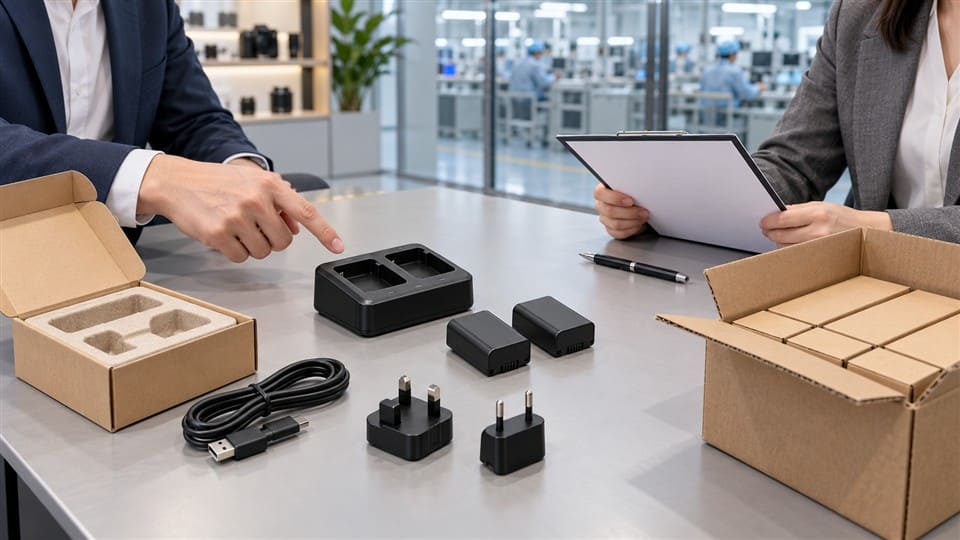
The Quotation Should Be More Than a Price
When I prepare quotations, buyers often ask for a single number. I understand why. They need to compare fast. But if the quotation only says “charger: USD X,” it is not enough for a purchasing decision.
A better quotation should include:
- Product model or item number
- Compatible battery models
- Unit price
- MOQ
- Packaging type
- Whether cable is included
- Plug type if relevant
- Lead time
- Carton quantity and approximate carton size
- Gross weight and net weight if available
- Payment terms
- Warranty or after-sales handling method
- Validity period of quotation
These details help buyers compare suppliers fairly. If Supplier A includes a retail box and USB cable, but Supplier B only includes bulk packing, the prices are not equal.
Example of a Better Comparison Table
| Quotation Item | Supplier A | Supplier B |
|---|---|---|
| Unit price | $1.20 | $1.05 |
| Packaging | Color box | Bulk bag |
| Cable included | Yes | No |
| MOQ | 500 pcs | 1,000 pcs |
| Lead time | 15–25 days | Not confirmed |
| Compatibility list | Provided | General answer |
| After-sales policy | Discussed | Not mentioned |
In this example, Supplier B is cheaper. But the buyer still needs to add cable cost, packaging cost, and possible risk cost. The final difference may not be so large.
MOQ and Lead Time Need Realistic Discussion
For African and Latin American buyers, MOQ can be very important. Some wholesalers want mixed models because one single charger model may not sell enough volume. Some retailers need smaller trial orders before larger repeat orders.
A practical manufacturer should explain:
- Which models can be mixed
- Minimum quantity per model
- Whether packaging can be customized
- Whether neutral packaging is available
- Lead time for stock models
- Lead time for made-to-order packaging
I would not suggest trusting unrealistic promises. If a supplier says every model, every package, and every quantity can ship immediately, buyers should confirm stock status carefully.
Packaging Affects Sales
Packaging is not only decoration. In retail and online channels, packaging affects customer trust.5 For camera battery chargers, common packaging options may include:
- Bulk packing
- White box
- Color box
- Blister packaging
- Customized brand packaging
Each option has a different cost and purpose. Bulk packing may suit wholesalers. Color box packaging may be better for retail shops. Customized packaging may help online sellers build a brand, but it usually needs higher MOQ and longer preparation time.
The key is to match packaging to your sales channel. A low-cost bulk package may save money, but it may not sell well in a shop display. A beautiful box may help retail sales, but it may not be necessary for a price-sensitive wholesale order.
How Can African and Latin American Buyers Reduce Return Risk?
Return risk can hurt profit more than buyers expect.6 A few defective items are not the only issue. The bigger problem is the time spent handling complaints, replacing products, and rebuilding trust with retailers or online customers.
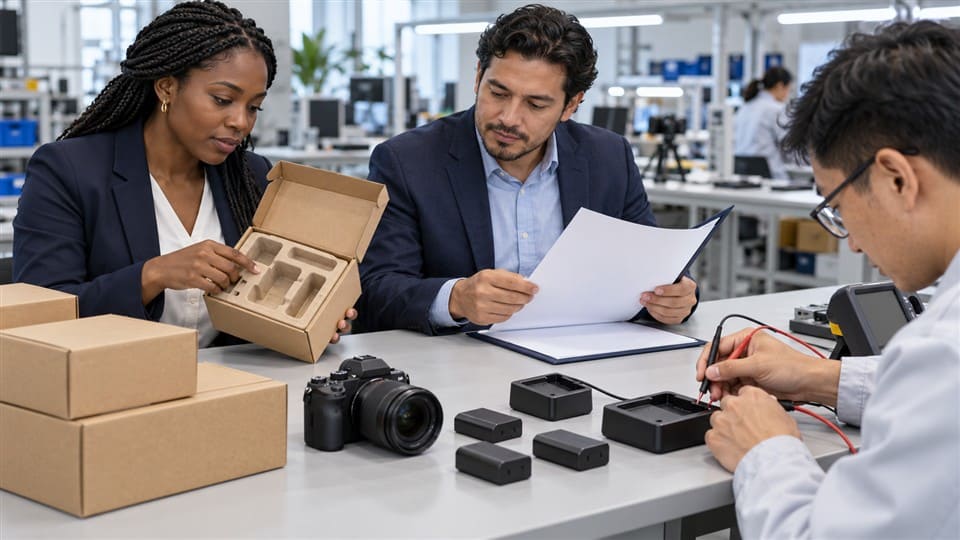
African and Latin American buyers can reduce return risk by confirming compatibility, testing samples, choosing suitable packaging, clarifying after-sales terms, and starting with realistic quantities. Buyers should also verify any required compliance documents for their own target country before importing.
Start With Samples When Possible
When buyers are entering a new charger model, I usually recommend samples if the order plan allows it. Samples help buyers check the product before committing to a larger order. They can test the basic selling points in their own market.
A sample check can include:
- Does the charger fit the target battery model?
- Does the battery sit firmly in the slot?
- Does the charging indicator work clearly?
- Is the packaging acceptable for the sales channel?
- Is the cable quality acceptable?
- Does the product label match the buyer’s expectation?
- Does the customer understand how to use it?
This is not the same as professional laboratory testing.7 For application-specific requirements, buyers should use qualified technical evaluation. But for purchasing decisions, sample checking is a practical first step.
Think About the Local Sales Channel
A wholesaler, importer, retailer, and online seller may need different charger solutions.
| Buyer Type | Main Concern | Suggested Focus |
|---|---|---|
| Wholesaler | Price and supply stability | MOQ, carton packing, repeat price |
| Importer | Market coverage | Model range, compatibility list |
| Retail shop | Sellable display | Color box, popular models |
| Online seller | Customer reviews | Clear listing, packaging, low complaint risk |
For example, an online seller may prefer better packaging and a clear model label because customers judge quickly after delivery. A wholesaler may care more about carton strength and mixed-model availability.
Clarify After-Sales Handling Before Payment
After-sales terms should be discussed before the order, not after a problem appears. Buyers can ask:
- What happens if some units are defective?
- Will the supplier provide replacements, credit, or another solution?
- What proof is needed for after-sales claims?
- How long is the after-sales period?
- Will the same terms apply to repeat orders?
The answer does not need to be complicated. It just needs to be clear. In many cases, simple written agreement prevents later conflict.
Verify Documents for Your Country
Different countries may have different import, safety, labeling, or documentation requirements.8 I do not suggest assuming that one document works everywhere. Buyers should check with their local customs broker, importer, or qualified compliance professional.
If a supplier provides certificates or reports, buyers should verify:9
- Document name
- Product model covered
- Issuing organization
- Validity date
- Whether it matches the shipment product
- Whether it is accepted in the target country
This is especially important for buyers serving formal retail chains or marketplaces with strict product requirements.
How Do You Choose the Right Camera Battery Charger Manufacturer in China for Repeat Orders?
A first order is important, but repeat orders are where buyers build real profit. If product quality, packaging, or price changes too much, the buyer may lose customer confidence. Stable replenishment matters.
The right camera battery charger manufacturer in China for repeat orders should offer consistent quality, realistic lead time, clear model support, stable packaging options, and responsive communication. Buyers should choose a supplier that can grow with their market, not only win one order with a low quote.

Repeat Orders Need Stability
For many African and Latin American buyers, the first order is a market test. If the charger sells well, the next challenge is replenishment. The buyer needs to restock before retailers run out. If the supplier changes materials, packaging, or delivery time without notice, the buyer may face problems.
In my own factory-side discussions, repeat buyers usually care about four things:
- Can you keep the same charger model?
- Can you keep the same packaging?
- Can you ship within the expected lead time?
- Can you support more models later?
These questions are practical. They are not about theory. They are about keeping sales moving.
Communication Is Part of Supplier Capability
A good supplier does not only produce goods. A good supplier also communicates clearly. For camera battery charger sourcing, communication should include:
- Fast confirmation of compatible models
- Clear quotation updates
- Honest lead time discussion
- Packaging photo confirmation
- Production or shipment updates
- Support when issues appear
Slow communication is not always a sign of bad quality. But when sourcing technical accessory products, unclear answers increase risk. If the buyer cannot confirm basic product details before payment, handling a problem after shipment will be harder.
Factory or Trading Company?
Some buyers ask me whether they must choose a factory instead of a trading company. My answer is balanced. A source factory may offer price advantage, direct product discussion, and better control over production details. But a good trading company may also provide value if it manages sourcing well.
The real question is not only “factory or trader?” The better question is:
“Can this supplier control the charger quality, compatibility, packaging, lead time, and after-sales process that my market needs?”
As a manufacturer, I believe direct factory cooperation can help buyers reduce cost and improve communication. But buyers should still evaluate every supplier carefully. No supplier type should be trusted blindly.
A Practical Supplier Scorecard
Buyers can use this simple scorecard before ordering:
| Evaluation Area | Score 1–5 | Notes |
|---|---|---|
| Price competitiveness | Is it reasonable, not just lowest? | |
| Compatibility clarity | Are models clearly confirmed? | |
| Packaging options | Does it match your sales channel? | |
| MOQ flexibility | Can it support your order size? | |
| Lead time reliability | Is the schedule realistic? | |
| Communication | Are answers specific and fast? | |
| After-sales support | Are terms clear before order? | |
| Repeat order support | Can supply stay stable? |
This type of scoring makes supplier selection less emotional. It helps buyers avoid choosing only by the cheapest quotation.
Frequently Asked Questions
What is the most important factor when choosing a camera battery charger supplier?
The most important factor is product-market fit. The charger must match the battery models your customers use. After that, buyers should compare charging stability, packaging, MOQ, lead time, price terms, and after-sales support before making a decision.
Should I always choose the lowest camera battery charger price?
No. A low price is useful only when the product specifications, packaging, compatibility, and after-sales terms are clear. If the lower price creates higher returns or slow sales, the total cost may become higher than a slightly better product.
How can I confirm camera battery charger compatibility?
You can send the supplier battery model numbers, camera model information, and clear photos of the battery. You should ask for a compatible model list in writing. If possible, you can also test samples before placing a larger order.
What packaging is best for camera battery chargers?
The best packaging depends on your sales channel. Bulk packing may suit wholesalers. Color boxes may suit retail shops. Customized packaging may support online sellers or brand owners, but it usually needs higher MOQ and longer preparation time.
Do I need to verify certificates before importing camera battery chargers?
Yes. Buyers should verify any certificates, test reports, labels, or import documents required in their target country. Requirements may differ by market, so it is better to confirm with a local customs broker or qualified compliance professional.
Conclusion
Choosing a camera battery charger manufacturer in China is really about reducing purchasing risk. Price is important, but it should be compared with compatibility, packaging, MOQ, lead time, and after-sales support. From my factory-side experience, the best buyers ask clear questions before ordering, especially about model matching and repeat supply. If you are sourcing camera battery chargers or camera batteries for Africa or Latin America, contact us with your target models and market needs. We can help you compare practical options for wholesale, retail, or online resale.
-
"Subpart 46.7 – Warranties", https://www.acquisition.gov/far/subpart-46.7. Research and technical guidance on consumer electronics reliability indicate that component selection, connector design, and cable quality influence product usability and failure risk; the support is technical and contextual, not a direct market study of camera charger accessories. Evidence role: general_support; source type: research. Supports: Electronic accessory performance and reliability depend on component quality, connector design, cable quality, and documented specifications.. Scope note: Contextual electronics reliability support. ↩
-
"Battery nomenclature", https://en.wikipedia.org/wiki/Battery_nomenclature. Background sources on battery nomenclature describe multiple battery naming conventions and model-code systems used to identify size, chemistry, and manufacturer designations; this provides contextual support for possible confusion but does not address camera batteries alone. Evidence role: definition; source type: encyclopedia. Supports: Battery identification can involve formal nomenclature systems and manufacturer-specific model designations, which can create ambiguity for buyers.. Scope note: Contextual nomenclature support rather than direct sourcing evidence. ↩
-
"An Evaluation of Product Descriptions and Brand Trust as …", https://digitalcommons.spu.edu/cgi/viewcontent.cgi?article=1006&context=rpsy_etd. Studies of online reviews and expectation disconfirmation find that mismatches between product information and received product attributes are associated with lower satisfaction and more negative review behavior; the evidence is general e-commerce evidence rather than charger-specific data. Evidence role: mechanism; source type: paper. Supports: When products fail to meet stated expectations, customer satisfaction and online ratings tend to decline.. Scope note: General online retail mechanism, not a camera charger dataset. ↩
-
"SOP-PURCH-03: Competition and Sourcing: Procedures", https://procurement.iu.edu/sop/sop-purch-03.html. Procurement guidance on RFQ preparation emphasizes that quotations should be evaluated against defined specifications, quantities, delivery terms, and conditions so that offers are comparable; this supports the article’s warning about vague quotations but does not document a specific charger sourcing case. Evidence role: expert_consensus; source type: institution. Supports: Formal procurement guidance recommends that requests for quotation and supplier quotations clearly define specifications, quantities, delivery terms, and commercial conditions.. Scope note: General procurement process support. ↩
-
"The Impact of Visual Elements of Packaging Design on … – PMC", https://pmc.ncbi.nlm.nih.gov/articles/PMC11851823/. Consumer-behavior research on product packaging finds that packaging design and presentation can affect perceived quality, trust, and purchase intention; the support is general and does not prove the effect size for camera battery chargers. Evidence role: general_support; source type: paper. Supports: Packaging can influence perceived product quality, trust, and purchase intention.. Scope note: General consumer packaging research. ↩
-
"Opportunistic Returns and Dynamic Pricing: Empirical …", https://www.hbs.edu/ris/Publication%20Files/19-030_39bfa9af-36e1-4956-a9cd-01024f50122b.pdf. Research on returns management and reverse logistics shows that product returns create costs for transport, inspection, restocking, replacement, and customer service, which can reduce profitability; the evidence is broadly applicable to retail supply chains rather than specific to camera charger importers. Evidence role: statistic; source type: paper. Supports: Returns impose direct and indirect costs that can reduce seller profitability.. Scope note: General returns-management evidence. ↩
-
"Requirements Pertaining to Third Party Conformity …", https://www.cpsc.gov/Regulations-Laws–Standards/Rulemaking/Final-and-Proposed-Rules/Third-Party-Conformity-Assessment-Bodies. Conformity-assessment standards such as ISO/IEC 17025 define competence requirements for testing and calibration laboratories, distinguishing formal laboratory evaluation from informal inspection or sample use; this supports the distinction but does not specify which tests are required for every charger market. Evidence role: definition; source type: institution. Supports: Accredited laboratory testing follows recognized competence and testing requirements that differ from informal buyer sample checks.. Scope note: Defines formal testing competence, not market-specific compliance requirements. ↩
-
"China – Labeling/Marking Requirements", https://www.trade.gov/knowledge-product/china-labelingmarking-requirements. Government trade guidance and WTO technical-barriers materials describe how product standards, labeling rules, conformity assessment, and import documentation differ across national markets; this supports the need to verify target-country requirements but does not identify the requirements for a particular charger shipment. Evidence role: historical_context; source type: government. Supports: Countries maintain different technical regulations, standards, labeling rules, and import documentation requirements for products.. Scope note: Regulatory context only; country-specific confirmation is still needed. ↩
-
"FAQs – Certification and Third Party Testing", https://www.cpsc.gov/Business–Manufacturing/Testing-Certification/Third-Party-Testing/FAQs-Certification-and-Third-Party-Testing-OLD. Accreditation and conformity-assessment guidance indicates that test reports and certificates should be checked for issuing body, accreditation status, scope, product identification, and validity, supporting the article’s verification checklist while not confirming any individual supplier document. Evidence role: expert_consensus; source type: institution. Supports: Certificate and test-report verification should include the issuing body, scope, product identification, and validity information.. Scope note: General certificate-verification guidance. ↩